
MFL Department Support Resource
Everyone benefits when MFL teachers collaborate, exchange ideas, and share effective strategies. This resource consists of a collection of team-led training activities that collectively will help you to encourage collaboration amongst MFL teachers.
A collaborative approach helps ensure consistency, enriches classroom practice, and supports the successful implementation of the curriculum. The resource recognises that every school context and every teacher is different and so should not be seen as prescriptive; it is for teachers to decide how they want to work for the benefit of their students.
How to use this resource
First, you will fill in a needs analysis grid, ranking statements about your MFL department based on a RAG (Red, Amber, Green) status system. The resulting profile will link you to appropriate training resources from a resource bank, based on what aspects of your department’s practice you highlighted as “amber” or “red” . Each training activity lasts up to 40 minutes and will enable you to develop different facets of your team.
Getting started: needs analysis profile
Firstly, to help you to understand your needs as an MFL Department, you will fill in a needs analysis profile.
- Download the needs analysis profile grid. It is based on a RAG (Red, Amber, Green) status system.
- Go through each of the statements and assign a RAG status to each aspects of your department’s practice. Type R/A/G into the first column.
R: We do not do this as a department and do not know how to implement it.
A: We are starting to do this but need more support.
G: We do this as a department and are confident that we do it well.
The statements that you designate as amber or red will display a link to the appropriate training resource, which you can then download and use.
Resource bank
How are the resources structured?
Each resource guides you through a training activity. The resources are grouped into five sections, and should be seen as part of the cyclical process of establishing, monitoring and evaluating, where a department continually seeks to improve its approach and practice. The five sections are detailed below.
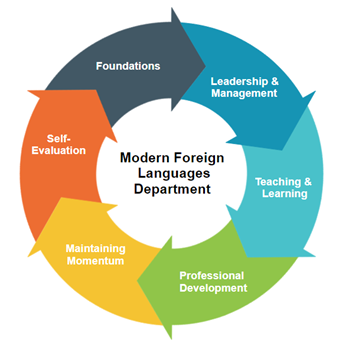
Foundations
These activities are designed to bring language teachers together to form common goals, outlooks and visual identity.
Leadership and Management
These activities are designed to collectively manage your department.
Teaching and Learning
These activities will help you to design departmental policy to support teaching and learning in the classroom.
Professional Development
These activities will help you to identify the needs of your team and how to address them.
Maintaining Momentum
These activities will help you to review your progress as a department and how to overcome challenges.
Self-evaluation
These activities are designed to help you evaluate your progress as a department and areas for improvement.